User Journey Mapping for GI Chronic illness
The Strategy of the "Unfortunate New Norm"
When we talk about UX in health tech, we often focus on the interface, but the true"system" begins at the moment of diagnosis. For anyone navigating a GI chronic illness, life quickly becomes a high-stakes strategy game where the goal is simply to exist without pain.
I’ve spent 20 years applying systems thinking to product design, but nothing prepared me for the "Black Box" of a medical journey. I realized that most clinical guidance stops at the clinic door, leaving patients to navigate a complex landscape of "hidden" ingredients and "Catch 22" dietary choices on their own.
I created this GI Chronic Illness Journey Map to visualize the three distinct phases patients cycle through:
- Phase 1: Diagnosis & Uncertainty. The "Information Chaos" phase, where patients are flooded with conflicting data and a desperate search for a baseline.
- Phase 2: Stabilization & The Setback Loop. A precarious state where a single failed experiment leads to a "Flare Reset," creating a deterrence effect that stops progress toward remission.
- Phase 3: Remission & The Social Wall. The "Spectator Reality," where being physically healthy means being socially isolated, choosing between
medical safety and social participation.
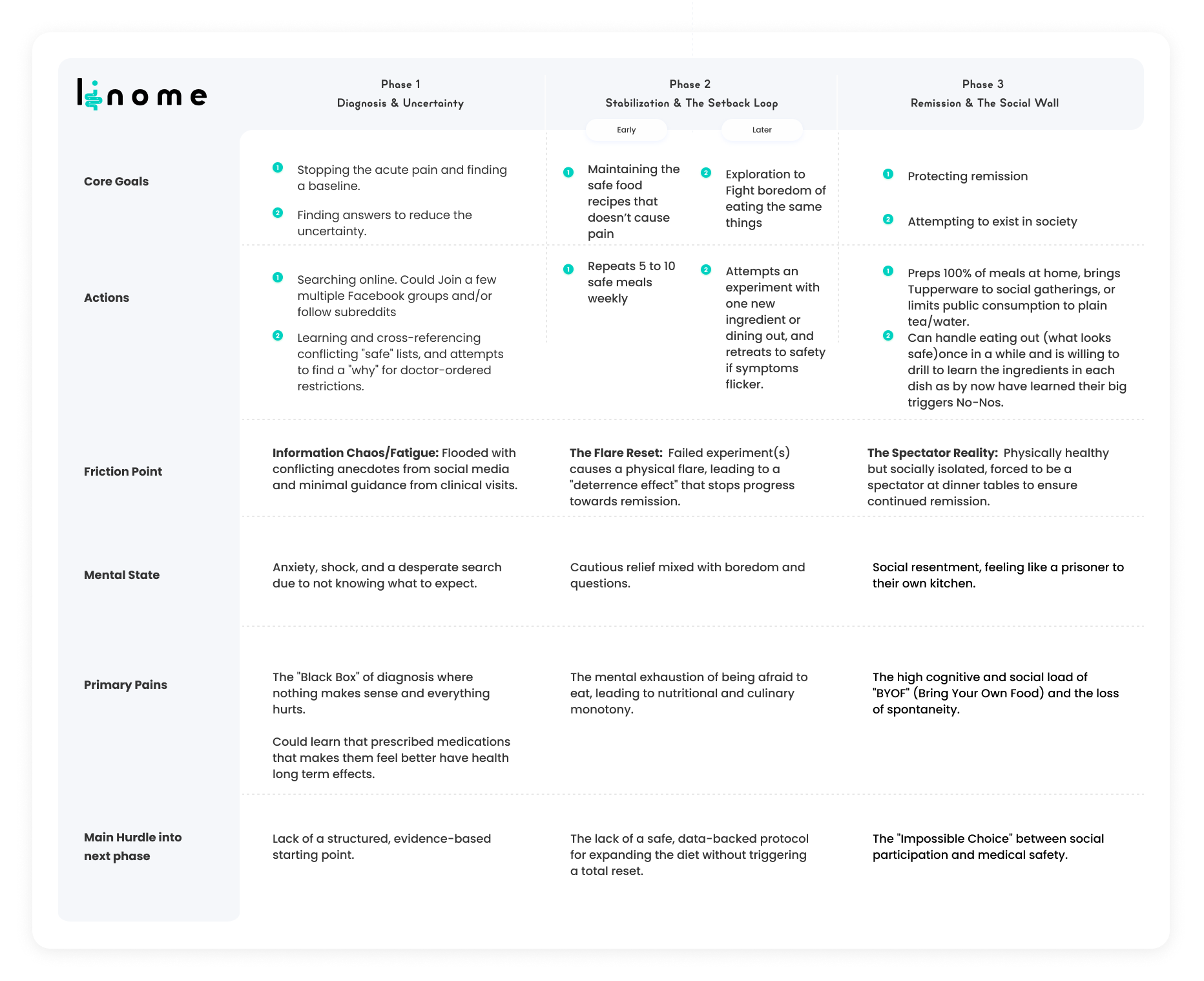
Linome - User Journey Mapping for Phases of GI Chronic illness
As a UX professional, I see these not just as medical milestones, but as massive friction points where our current solutions fail the user. We need tools that move beyond generic tracking and address the high cognitive load of staying safe in a world of "hidden" triggers.
That's why I am creating Linome. My work on Linome is grounded in this data, aiming to solve the impossible choice between "eat and feel bad" or "be deprived and feel good." We are building for the human technicality of a high-performing recovery.
Disclaimer: I am a UX Design Leader and Researcher, not a medical professional. The insights and journey maps shared here are based on user experience research and my personal journey navigating chronic illness. This content is for informational and design-strategy purposes only and should not be taken as medical advice, diagnosis, or treatment. Always seek the advice of your physician or other qualified health provider with any questions you may have regarding a medical condition.